
Review by Philip Gooden
On stage|: 28 July – 1 August
There’s quite an overlap between 20th century English novelists and the secret world of Intelligence. Writers like Ian Fleming and John le Carré had actual experience of what they were writing about and took the subject seriously but Graham Greene, who worked for MI6 in Sierra Leone during the Second World War, looked at things with an altogether more sardonic eye.
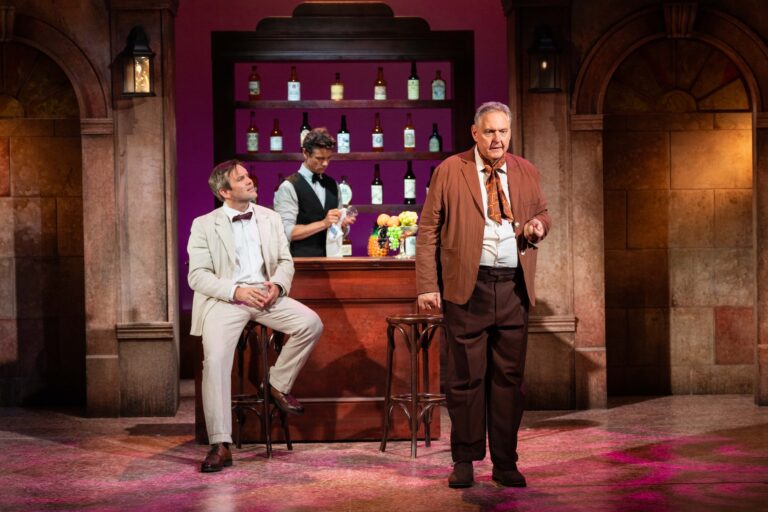
Greene was famous for his exploration of out-of-the-way places and during the early 1950s he made several visits to Havana ‘in search of pleasure’, as the narrator puts it in actor Clive Francis’s adaptation of Our Man in Havana, first staged in 2007 and now revived at the Oxford Playhouse in a touring production. The setting is Cuba in the pre-Castro period when Havana was a haven of brothels, roulette, corruption and police brutality, a place ‘where every vice was permissible’.
On an evening when the outside temperature perhaps rivalled that in Havana, a full house in the air-conditioned theatre was treated to a finely realised set by Julie Godfrey (also costumes), evoking the heat, frenzy and colour of that capital city.
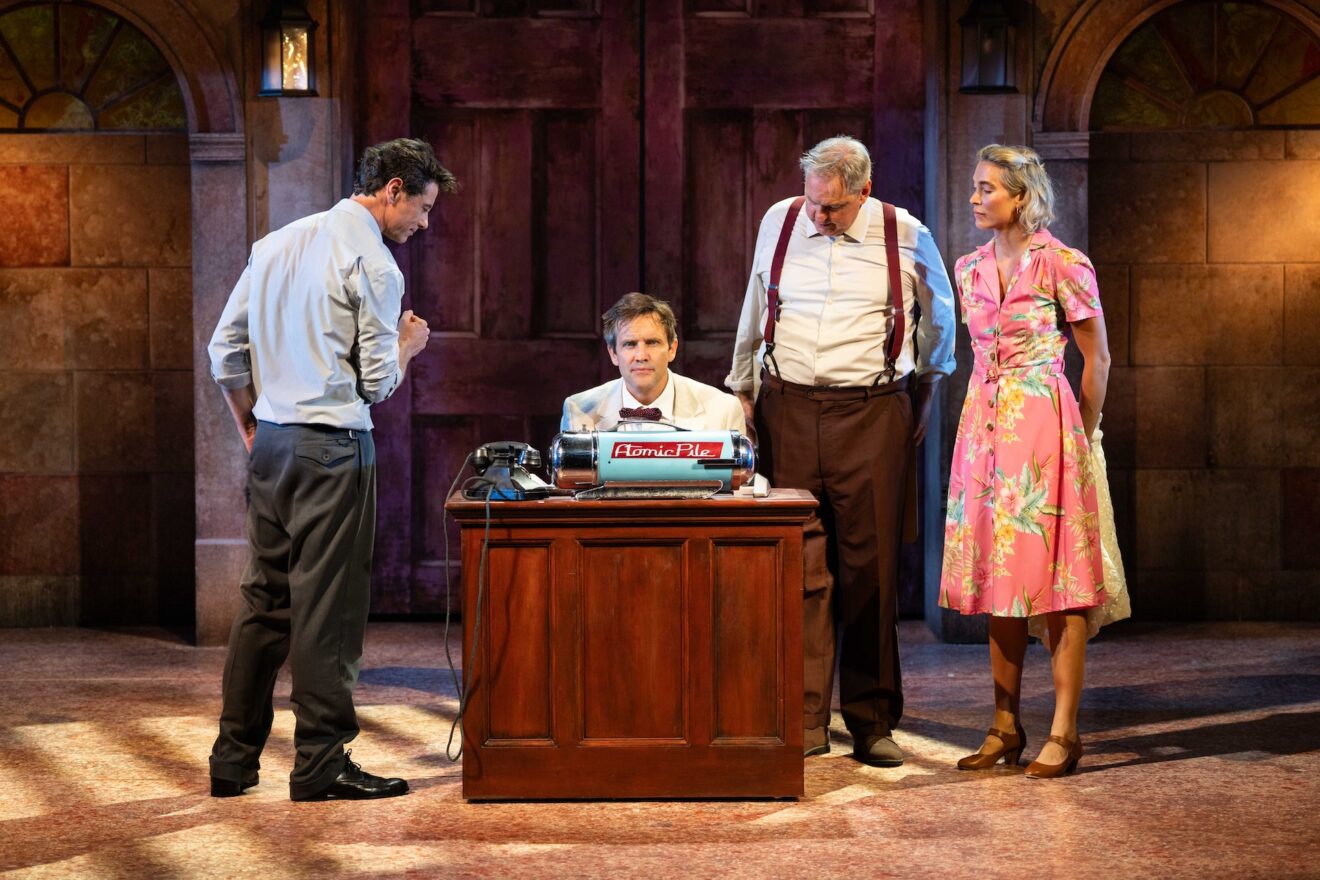
Greene’s wry take on the espionage business was to turn his protagonist James Wormold into an expat vacuum-cleaner salesman. (In passing, is there a more unBond-like name than Wormold?) Recruited by Hawthorne from the British Secret Service – a scene which takes place in the seedy Gents at a bar – Wormold (Jack Ashton) discovers that he’s become ‘our man in Havana’ almost inadvertently. His motive isn’t so much patriotism as the need to make money to placate his teenage daughter Milly (Jodie Steele), who is quite prepared to throw a tantrum if she can’t have a horse.
The ineffectual salesman is totally unfitted to be a spy but he does have at least one asset, a quick imagination. When London pressures him to come up with the goods, he creates a roster of imagined sub-agents, on whose behalf he can of course claim more expenses. He also draws diagrams of vacuum cleaner parts with the pretence that they’re images of new secret weapons, an uncanny foreshadowing of what happened some years later during the Cuban Missile Crisis.
Inevitably everything starts to go wrong when one of the invented agents comes to life, or rather death in road accident. It seems that Wormold’s creations, like a novelist’s characters, are taking on a life of their own and running out of his control.
Our Man in Havana has a cast of four who, with the exception of Jack Ashton in the pivotal role, change outfits and accents with lightning speed as they juggle with more than thirty roles. I particularly enjoyed Leon Ockenden’s turn as the sinister, pomaded Captain Segura and Bob Barrett’s portrait of the melancholic German Dr Hasselbacher, the one resident of Havana for whom Wormold feels anything like affection.
This is intentionally a broad-brush, sometimes cartoonish production under the direction of Philip Wilson, which relies on stereotypes like the excitable Latino and the phlegmatic Englishman. It moves at a hectic pace with some dextrous changes of scene and contains set pieces that are both farcical and ominous, a faithful reflection of Greene’s original book and indeed his world-view.
★★★★☆. Philip Gooden. 29 July 2026
Photography credit: Jack Merriman
With thanks to Stage Talk Magazine