
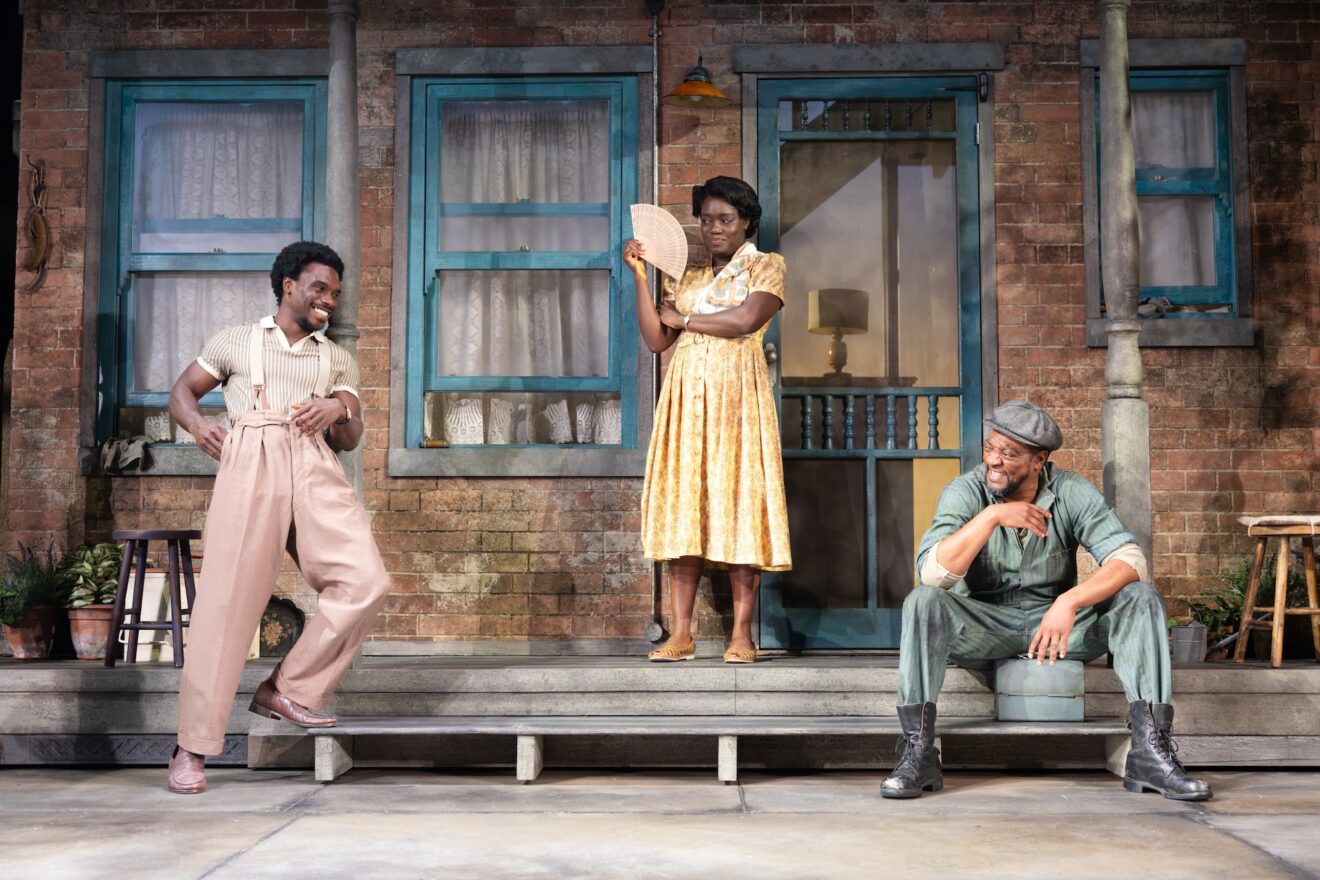
30 September – 3 October
It’s 1957 and we’re in Pittsburgh at the heart of a black working-class community. The setting is the porch and yard of a meagre property belonging to garbage man Troy Maxson, his wife Rose and son Cory. Troy is an uncompromising figure, attractive but domineering, the pivot around whom the other characters revolve. They include Lyons, an older son by another woman, his brother Gabe, and his friend and drinking partner, Bono.
This impressive Leeds Playhouse/Headlong revival of August Wilson’s classic drama highlights both universal aspects of family life and ones particular to a moment in American black history. Yes, it’s about infidelity, masculine authority, clashing ambitions and the tension between generations, but director Daniel Bailey’s intense production also shows how every aspect of daily existence cannot help but be filtered through the prism of race.
At the start Troy – a magnetic performance by Ray Fearon – is angry that a ‘colored’ can’t be promoted to driving a garbage truck. He’s resentful that Cory might get somewhere as a baseball player, believing he was held back from similar success by racial discrimination. When the easy-going Bono (Everal A Walsh) tells him that ‘Times have changed…You just come along too early’, Troy’s angry response is ‘There ought not never have been no time called too early!’, which simultaneously makes a character point and underlines the long-standing injustices of the American system.
Madeline Appiah as Rose, subtly conveying her love and occasional exasperation with her husband in the first half, really comes into her own in the second act with a moving outburst that shifts the dynamic between the couple. Josh Tedeku is similarly effective as young Cory, fearful of his father but determined to strike out on his own. The older son Lyons (Michael Ahomka-Lindsay) is an aspiring jazz player, a cool cat always destined for disappointment because his father won’t come to his performances (‘I don’t like that Chinese music.’).
Family conflict is at the centre of Fences but it is leavened by affection and humour. Ambiguity too. Troy is loving enough towards Gabe, the younger brother who sees visions as a result of a head wound, but he also takes advantage of the compensation which the war veteran receives. Gabe, in an affecting performance by Simon-Anthony Rhoden, opens and closes the drama as he plays on the trumpet which forever dangles round his neck. The angel Gabriel or a benignly mad middle-aged man? Both perhaps.
Troy is, in effect, the dramatist of his own life and he spins tales which keep his family (and the audience) riveted. We get a sense of the black experience through the first half of the twentieth century and a full-length portrait of a conflicted man, one who is obsessed with repairing the yard fence, both an image of the coldness between himself and his sons and the barrier which, in an impassioned monologue, Troy imagines as keeping death and his sickle at bay.
This is a memorable revival, with lighting (Jai Morjaria) running from ice blue to smoky orange and reflecting the shifts of the music (Khalil Madovi) from frantic to warm. The naturalistic set by Lily Arnold is more complicated than first appears and that might serve as a metaphor for a production which deservedly received a standing ovation on the night I went.
★★★★★ Philip Gooden, 1 October 2026
With thanks to StageTalk
Photography credit: Tyler Fayose